

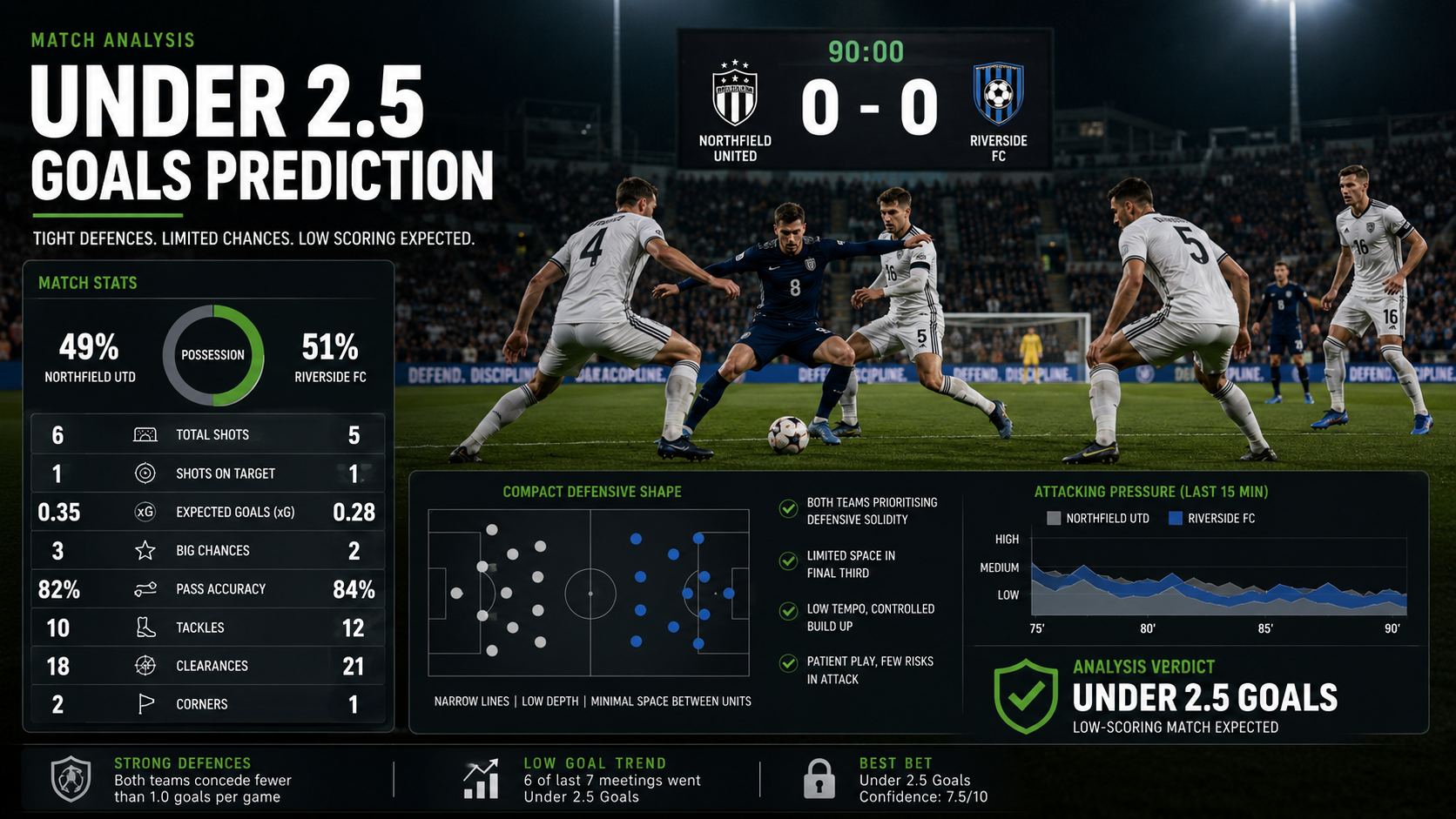
How to Predict Under 2.5 Goals in Football
Predicting under 2.5 goals in football means looking for matches where the total number of goals is likely to be two or fewer. This football prediction strategy is useful when you expect a tight, tactical, defensive, or low-scoring game. Unlike win-draw-win betting, under 2.5 goals does not require you to choose the team that will win. Instead, your focus is on the total number of goals scored by both teams combined.
An under 2.5 goals prediction wins when the final score has fewer than three total goals. These scorelines are winning under 2.5 goals results: 0-0, 1-0, 0-1, 1-1, 2-0, 0-2. These scorelines are losing under 2.5 goals results: 2-1, 1-2, 3-0, 0-3, 2-2, 3-1, 4-0.
Many football matches look exciting before kick-off, but not every match produces goals. Some teams are defensive, some lack creativity, some struggle to finish chances, and some matches are played with caution because of pressure or importance. To predict under 2.5 goals correctly, you need to study recent results, defensive records, attacking weaknesses, team news, playing style, home and away form, and match motivation. Browse all our available markets on the football predictions page.
What Does Under 2.5 Goals Mean?
Under 2.5 goals means the match must finish with zero, one, or two total goals. The goals can be scored by either team, but the combined total must not reach three.
For example, a 1-1 draw is a winning result for under 2.5 goals because the total number of goals is two. A 2-0 result is also a winning result because the total is still two. However, a 2-1 result loses because the total number of goals is three. If you expect at least two goals, our over 1.5 goals predictions may be suitable.
The reason the market uses “2.5” is to avoid a middle result. Since a football match cannot finish with exactly 2.5 goals, the result is either under or over.
Check Recent Low-Scoring Matches
The first step in predicting under 2.5 goals is to check the recent matches of both teams. Look at their last five to ten games and count how many finished with fewer than three goals.
If a team regularly plays matches that end 0-0, 1-0, 1-1, or 2-0, it may be suitable for under 2.5 goals predictions. However, you should not check only one team. Both teams must be analysed together because the style of both sides affects the total number of goals.
For example, if Team A has produced under 2.5 goals in seven of its last ten matches and Team B also has many low-scoring results, the match may be worth considering. But if one team is constantly involved in 3-2, 4-1, or 2-2 matches, the risk becomes higher.
Recent results are useful, but you must also understand the reason behind them. A team may have low-scoring results because it faced strong defensive opponents. Another team may have low-scoring matches because it struggles to create chances. The scoreline alone is not enough. You need to understand the pattern.
Analyse Defensive Strength
Strong defensive teams are very important when predicting under 2.5 goals. A well-organised defensive team can reduce the number of chances in a match, block shots, protect the goalkeeper, and slow down attacking pressure. Countries like Italy are known for producing defensively solid teams.
When analysing defensive strength, check how many goals the team concedes per match. Also look at clean sheets, shots conceded, big chances allowed, and defensive discipline. A team that regularly concedes zero or one goal is more suitable for under 2.5 goals than a team that concedes two or three goals often.
Good defensive signs include clean sheets in recent matches, low goals conceded average, few shots allowed, few big chances conceded, strong centre-backs, disciplined defensive midfielders, a reliable goalkeeper, and a compact team shape.
You should also look at how the team defends against different types of opponents. Some teams defend well against weaker sides but struggle against fast attacking teams. Others remain compact regardless of the opponent. The stronger and more consistent the defence, the better the under 2.5 goals signal becomes.
Look for Weak Attacking Teams
Under 2.5 goals is not only about strong defending. It is also about attacking weakness. Our both teams to score predictions cover matches where goal action from both sides is expected. A match becomes more suitable for under 2.5 goals when one or both teams struggle to score.
Some teams may have plenty of possession but still create few clear chances. Others may depend too much on one striker. Some teams cross the ball often but do not have quality finishing. When a team lacks creativity, confidence, or attacking sharpness, it becomes harder for the match to produce many goals.
When studying attacking weakness, ask yourself: does the team struggle to score? Does the team create few shots on target? Are the forwards out of form? Is the main striker injured or suspended? Does the team lack creativity in midfield? Does the team rely too much on set pieces?
If both teams have poor attacking numbers, under 2.5 goals becomes more attractive. If one team is strong defensively and the other team struggles to score, the match may also be suitable for a low-scoring prediction.
Study Home and Away Goal Trends
Home and away performance can change how a team plays. Some teams attack more at home but become cautious away from home. Others defend strongly at home and make it difficult for opponents to create chances.
Before predicting under 2.5 goals, check the home team’s home matches and the away team’s away matches. This gives you a better picture of what may happen in the actual fixture.
For the home team, check home goals scored, home goals conceded, home clean sheets, home under 2.5 goals record, and home playing style. For the away team, check away goals scored, away goals conceded, away clean sheets, away under 2.5 goals record, and away defensive approach. Our home wins and away wins predictions provide additional insight into team performance.
A match may be good for under 2.5 goals if the home team is defensive, the away team struggles to score on the road, and both sides have a history of low-scoring matches in similar conditions.
Check Head-to-Head Records
Head-to-head results can help you understand how two teams usually perform when they meet. Some fixtures often produce tight games because both teams know each other well. Some rivals play cautiously because they do not want to lose. Other teams may have styles that cancel each other out.
Look at the last five meetings between the teams and check how many finished under 2.5 goals. If most of their recent meetings ended 0-0, 1-0, 1-1, or 2-0, that can support your prediction.
However, do not rely only on head-to-head history. Teams change managers, players, formations, and tactics. A match from three years ago may not be very useful if both teams are now different. Use head-to-head records as supporting evidence, not the main reason for your prediction.
Consider Match Importance
The importance of a match can affect the number of goals. Some important matches become open and attacking, but many become careful and tactical. When teams are afraid to lose, they may defend deeper and take fewer risks.
Cup finals, derby matches, relegation battles, first-leg knockout matches, and matches where one team only needs a draw can sometimes produce fewer goals. A double chance prediction can be useful when you expect a tight contest. Players may avoid mistakes, managers may set up cautiously, and the match tempo may become slower.
Before choosing under 2.5 goals, ask: is the match very important? Does one team only need a draw? Is it a cup final or knockout match? Are both teams likely to avoid risks? Could the first half be slow and cautious?
When pressure is high, some teams become more defensive. This can support an under 2.5 goals prediction, especially when the statistics also show low goal trends.
Look at Playing Style and Tempo
Playing style is one of the most important factors in under 2.5 goals predictions. Some teams naturally play slow football. They keep possession, reduce the tempo, and avoid taking unnecessary risks. For instance, matches in Serie A are often more tactical and can produce fewer goals. These teams can make matches less open.
Other teams defend deep and wait for counter-attacks. If they do not commit many players forward, the match may have fewer chances and fewer goals.
Under 2.5 goals is more likely when both teams show slow build-up play, defensive structure, low pressing, few shots on target, limited attacking risk, compact midfield shape, strong game management, and a careful first-half approach.
A slow match tempo usually reduces the chance of many goals. If both teams are patient, defensive, and cautious, the game may stay under 2.5 goals.
Use Shots and Shots on Target
Shots and shots on target are very useful when predicting low-scoring matches. A team may score few goals because it creates very little. If both teams produce few shots on target, under 2.5 goals becomes more likely.
Do not only look at total shots. A team can take many weak shots from long distance without creating real danger. Shots on target and clear chances are more important.
A low-scoring match often has few shots on target, few big chances, low attacking pressure, poor finishing quality, strong defensive blocks, and limited space in the final third. For precise scoreline predictions, visit our correct score predictions.
If both teams struggle to create clear chances, the match may be suitable for under 2.5 goals. If one team controls the ball but does not create dangerous opportunities, that can also support a low-scoring prediction.
Check Expected Goals Where Available
Expected goals, also called xG, can help you understand the quality of chances a team creates and concedes. A team with low attacking xG usually does not create many high-quality scoring chances. A team with low xG conceded usually prevents opponents from creating dangerous opportunities.
For under 2.5 goals, look for matches where both teams have low attacking xG or where both teams are strong at limiting chances.
For example, if Team A creates very little and Team B also has poor attacking numbers away from home, the match may have limited scoring opportunities. If both teams also concede low-quality chances, under 2.5 goals becomes more reasonable.
Expected goals should not be used alone, but it can be a helpful extra statistic when combined with recent results, team news, and tactical analysis.
Watch Team News Carefully
Team news can strongly affect under 2.5 goals predictions. Injuries, suspensions, and rotation can change the attacking or defensive strength of a team.
If a team is missing its main striker, creative midfielder, or key winger, it may struggle to score. This can support an under 2.5 goals prediction. However, if a team is missing important defenders or its first-choice goalkeeper, the match may become riskier.
Before predicting under 2.5 goals, check if the main striker is available, if key creative players are missing, if defenders are fully fit, if the first-choice goalkeeper is playing, if the manager is likely to rotate, and if the team has another important match coming soon.
Team news should always be checked before making any final football prediction because one injury or suspension can change the direction of the match.
Be Careful with Early Goals
One major risk in under 2.5 goals betting is an early goal. When a team scores early, the match can open up. The losing team may attack more, leaving spaces for counter-attacks. This can increase the chance of more goals.
However, not every early goal ruins an under 2.5 prediction. Some teams score early and then defend the lead. Others slow the match down and protect the result carefully. This is why team style matters.
If both teams are aggressive and likely to respond quickly after conceding, under 2.5 goals may be risky. But if one team is comfortable defending a lead and the other team lacks attacking quality, the match may still remain low-scoring.
Best Signs for Under 2.5 Goals
A match may be suitable for under 2.5 goals when both teams have recent low-scoring results, both teams defend well, one or both teams struggle to score, there are few shots on target, the home team is cautious, the away team has poor attacking form, the match is very tactical, key attackers are injured or suspended, both teams are under pressure not to lose, previous meetings were low-scoring, and the first half is likely to be slow. Our draw predictions section covers matches with similar characteristics.
The more signs you find, the stronger the under 2.5 goals prediction becomes. However, you should avoid forcing a prediction when the data is unclear.
Common Mistakes to Avoid
One common mistake is choosing under 2.5 goals only because the odds look low or safe. Low odds do not always mean the prediction is safe. You must still check the statistics and match situation.
Another mistake is ignoring attacking quality. If one team has a very strong attack and the other team defends poorly, under 2.5 goals may be dangerous.
You should also avoid relying only on league position. A top team can still be involved in a low-scoring match, while a bottom team can still play open football and concede many goals. Always analyse the actual match, not just the table.
Another mistake is ignoring team news. If defenders are missing, the chance of goals may increase. If attackers are missing, the chance of a low-scoring match may improve. Always check the final team situation before making your decision.
To better understand related goal markets, you can read our comparison of over 2 vs over 2.5 goals and BTTS vs over 2.5 goals.
Final Thoughts
Predicting under 2.5 goals in football requires careful analysis of defensive strength, attacking weakness, recent form, home and away records, team news, tactical style, and match importance. The best under 2.5 goals predictions usually come from matches where both teams are cautious, chances are limited, and the overall tempo is controlled.
A strong under 2.5 goals match is not simply a boring game. It is a match where the statistics and context suggest fewer clear chances, strong defensive organisation, and limited attacking risk.
However, football is unpredictable. Red cards, penalties, mistakes, early goals, and tactical changes can quickly affect the outcome. That is why it is important to bet responsibly, manage your stake, and avoid forcing predictions on matches with unclear signs.
Responsible Betting Note: Football predictions are not guaranteed. Always bet responsibly, use proper money management, and never bet with money you cannot afford to lose.