

How to Use Team Form for Football Betting
Team form is one of the most important factors to consider when making football predictions. It shows how a team has been performing recently and can help you understand confidence, consistency, scoring ability, defensive strength and overall momentum. When used correctly, team form can guide your football betting decisions and help you avoid relying only on league position or team reputation.
In football betting, form usually refers to a team’s recent results. This can include wins, draws, losses, goals scored, goals conceded, clean sheets, home performances, away performances and the quality of opponents faced. Many people look only at the last five results, but proper team form analysis goes deeper than simply checking whether a team won or lost.
For example, a team may have lost two matches but performed well, created many chances and conceded late goals. Another team may have won three matches but struggled throughout and benefited from weak opponents or lucky decisions. This is why team form should be studied carefully before making any football prediction.
Using team form for football betting means looking at recent performance in context. Browse all our available markets on the football predictions page. You need to understand what the results mean, how the team played, whether the form is improving or declining, and whether the upcoming match conditions support that trend. For example, in the Premier League, form can change quickly due to the competitive nature of the league.
What Does Team Form Mean in Football Betting?
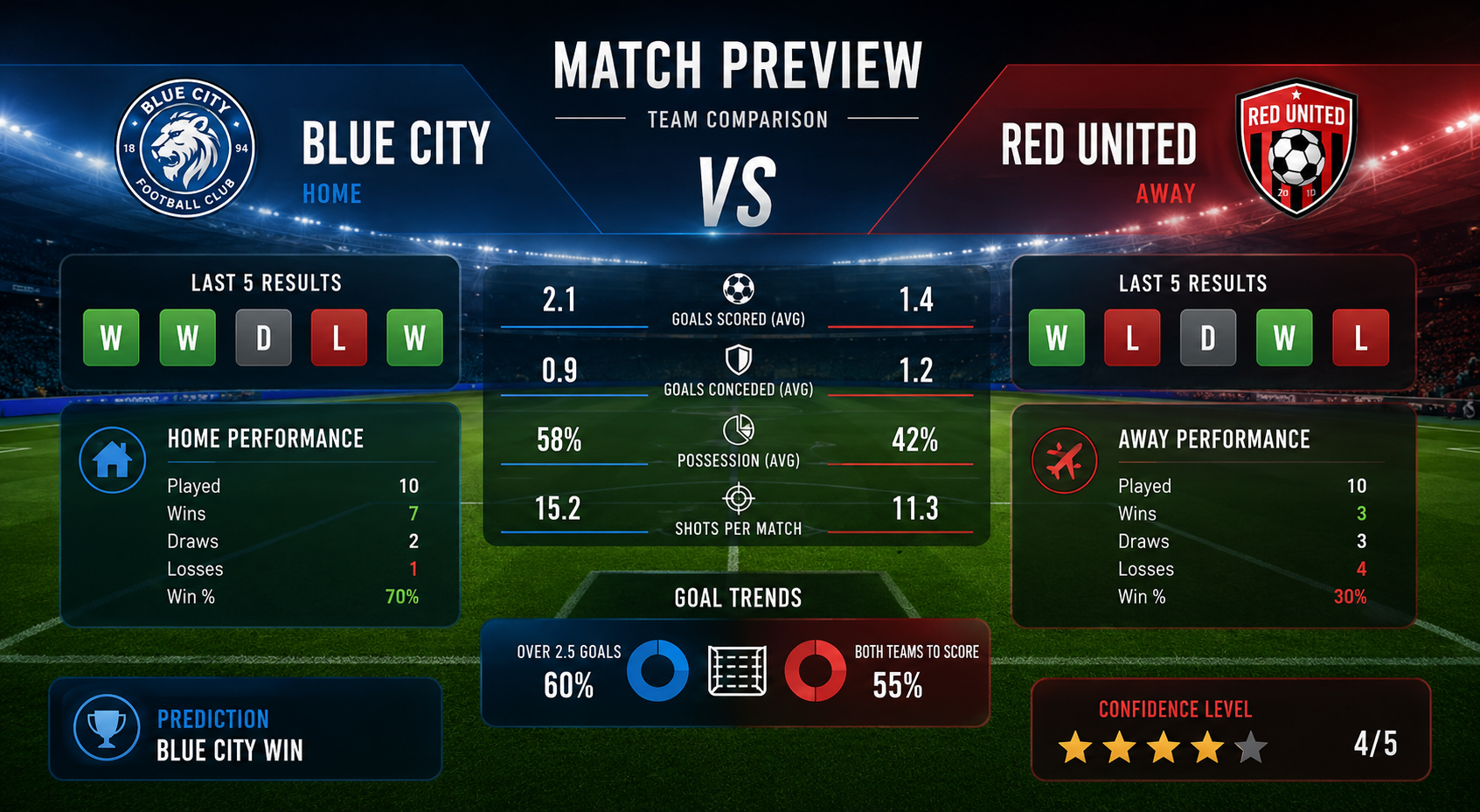
Team form refers to how well or badly a team has been performing over a recent period. Most football websites show form using letters such as W, D and L. W means win, D means draw and L means loss.
For example, a form line of W, W, D, L, W means the team won three matches, drew one and lost one in its last five games. A form line of L, L, D, L, W means the team has struggled recently, even though it managed to win one match.
However, team form is not only about results. A proper form analysis should also include goals scored, goals conceded, shots on target, clean sheets, attacking performance, defensive mistakes, injuries, fixtures, motivation and match location.
A team can be in good form because it is winning matches, scoring regularly and defending well. A double chance prediction can be useful when you expect a close match. A team can be in poor form because it is losing matches, conceding too many goals, struggling to score or lacking confidence.
Do Not Look at Wins and Losses Alone
One of the biggest mistakes in football betting is judging team form only by wins and losses. A team’s result does not always tell the full story.
A team may win 1-0 but play poorly, create very few chances and rely on a defensive mistake from the opponent. Another team may lose 2-1 but dominate possession, create many chances and perform better than the scoreline suggests.
This is why you should look beyond the final score. Ask yourself how the team played. Did they create clear chances? Did they control the match? Did they defend well? Were they unlucky? Did they face a very strong opponent? Were they missing key players?
Good betting analysis comes from understanding performance, not just results. When a team is playing well but results have not yet improved, it may offer value in future matches. When a team is winning but performing poorly, it may soon struggle.
Check the Last Five to Ten Matches
The last five to ten matches are a useful starting point when analysing team form. They can show whether a team is improving, declining or staying consistent.
A short five-match form guide can show recent confidence. A longer ten-match view gives you a better idea of consistency. If a team has been strong across ten matches, the form may be more reliable. If the form is based on only two or three games, you should be more careful. Our draw predictions section covers matches where the outcome may be shared.
For example, if a team has won four of its last five matches, that looks strong. But if those wins came against weak opponents, the form may not be as impressive. If another team has lost three of its last five but faced top clubs, the form may not be as bad as it looks.
When checking recent form, look at results, goals scored, goals conceded, clean sheets, home and away performance, opponent strength and match importance.
Compare Home and Away Form
Home and away form is very important in football betting. Some teams are strong at home but poor away. Others are comfortable on the road but struggle when expected to dominate at home. Countries like England have leagues with highly competitive home and away records.
Before making a prediction, check the home team’s recent home form and the away team’s recent away form. This gives you a clearer picture of what may happen in the actual match.
A team may have excellent overall form, but if most of its wins came at home and the upcoming match is away, you should be careful. Our home wins predictions and away wins predictions cover these patterns in detail. Likewise, a team with poor overall form may still be strong at home and difficult to beat.
For home form, check home wins, home goals scored, home goals conceded, home clean sheets and home attacking style. For away form, check away wins, away goals scored, away goals conceded, away defensive record and ability to handle pressure.
A strong football betting prediction should always consider where the match is being played.
Analyse Goals Scored and Goals Conceded
Team form becomes more useful when you include goals scored and goals conceded. A team that is winning regularly and scoring many goals is usually in strong attacking form. A team that is drawing or losing while conceding often may have defensive problems.
When analysing goals scored, check whether the team scores consistently. A team that scores in almost every match is more reliable for markets such as over 1.5 goals, over 2.5 goals, both teams to score or team goals.
When analysing goals conceded, check whether the team is defensively stable. A team that concedes regularly may be risky to back for a win, but useful for goal markets if the opponent has attacking quality.
For example, a team with recent results such as 2-1, 3-1, 2-2, 1-2, 4-1 may be useful for over goals or BTTS markets. A team with recent results such as 1-0, 0-0, 1-1, 2-0, 0-1 may be more suitable for under goals or cautious match predictions.
Look at the Quality of Opponents
Not all form is equal. A team that wins against weak opponents may look strong, but that does not always mean it will perform well against stronger opposition. A team that loses against top teams may not be in terrible form if it competed well.
This is why opponent quality matters. Before trusting a team’s form, check who they played against. Were they facing teams at the bottom of the table? Were they playing title contenders? Were the matches against strong defensive sides or open attacking teams?
For example, five unbeaten matches against weak teams may not be stronger than two wins, two draws and one loss against top opponents. Context is important.
You should also check whether the upcoming opponent is similar to the teams they recently faced. If a team has been beating defensive teams but now faces a fast counter-attacking team, the match may be different.
Check Whether the Form Is Improving or Declining
Team form is not always fixed. A team may be improving after a poor start, or declining after a strong run. Your job is to identify the direction of the form.
An improving team may start with poor results but gradually show better performances, more goals, stronger defending and more confidence. A declining team may still have good league position but recent performances may show warning signs.
Look at the pattern of recent matches. Is the team scoring more? Are they conceding fewer goals? Are key players returning? Has the manager changed tactics? Are performances becoming stronger?
Also check if the opposite is happening. Is the team conceding more? Are attackers missing chances? Are defenders making mistakes? Is confidence dropping? Are injuries increasing?
Football betting becomes stronger when you understand the direction of team form, not just the current record.
Consider Injuries and Suspensions
Team form can be affected by injuries and suspensions. A team may be in good form because its best players have been available. If those players are missing for the next match, the form may not continue.
Before trusting a team’s recent results, check the current team news. Is the main striker available? Are the best midfielders fit? Are key defenders suspended? Is the first-choice goalkeeper playing? Has the manager rotated the squad recently?
A team can look strong on paper but become weaker if important players are missing. A team can also improve quickly when key players return from injury.
For betting markets, this matters a lot. If a team is missing attackers, goal markets may become less attractive. If a team is missing defenders, the opponent may have a better chance of scoring. If a team is missing midfield control, the match may become more open.
Study Team Confidence and Momentum
Confidence is difficult to measure, but it plays a big role in football. A team on a winning run may play with more belief, attack with more freedom and defend with more organisation. A team on a losing run may become nervous, especially after conceding the first goal.
Momentum can affect how players react during difficult moments. Confident teams often recover better after setbacks. Struggling teams may panic, make mistakes or lose control of the match.
You can judge confidence by looking at recent performances, late goals, comeback wins, body language, manager comments, home crowd reaction and how the team performs under pressure.
However, do not overrate momentum. A winning run can end, and a losing run can stop. Confidence should support your analysis, not replace it.
Use Team Form for Different Betting Markets
Team form can help with different types of football betting markets. You should not use the same form analysis for every market. Each betting market needs a different focus.
For match winner predictions, look at wins, consistency, opponent quality, home and away form, defensive strength and current confidence.
For over 2.5 goals, look at goals scored, goals conceded, attacking form, shots on target, defensive weakness and open playing style.
For under 2.5 goals, look at low-scoring trends, strong defence, weak attacks, slow tempo and cautious tactics.
For both teams to score, look at whether both teams score regularly and whether both teams also concede.
For correct score predictions, look at recent score patterns, goal averages, defensive strength and likely match tempo.
This is why team form should be connected to the specific market you want to predict.
Avoid Emotional Betting
Many football bettors make emotional decisions based on favourite teams, big names or recent hype. This can lead to poor predictions. A popular team is not always in good form, and a smaller team is not always weak.
Team form helps you stay objective. Instead of betting because you like a team, you analyse how they are actually performing. This reduces emotional mistakes and helps you make better decisions.
Avoid betting on a team only because they won their last match. Also avoid betting against a team only because they lost recently. Always check the full context before making a decision.
Common Mistakes When Using Team Form
One common mistake is using only the last match to judge a team. One result does not prove strong or poor form. You need a wider sample.
Another mistake is ignoring home and away differences. A team may be strong at home but weak away. If you ignore this, your prediction may be misleading.
Another mistake is ignoring opponent quality. Winning against weak teams does not always mean a team is ready to beat stronger sides.
Some bettors also ignore team news. If important players are missing, recent form may become less reliable.
You should also avoid forcing a bet just because a team looks in good form. Sometimes the odds are too low, the opponent is difficult, or the match conditions are not favourable.
Best Signs of Strong Team Form
A team may be in strong form when it is winning regularly, scoring consistently, conceding few goals, creating chances, keeping clean sheets, performing well at home or away, showing confidence, avoiding injuries and beating good opponents.
The best team form is balanced. A team that scores well and defends well is usually more reliable than a team that only attacks but concedes too easily.
However, strong form does not guarantee a win. It only gives you better information for your prediction.
To better understand related goal markets, you can read our comparison of over 2 vs over 2.5 goals and BTTS vs over 2.5 goals.
Final Thoughts
Using team form for football betting is one of the best ways to improve your football predictions. It helps you understand how a team is performing, whether it is improving or declining, and whether the upcoming match suits its current pattern.
Good form analysis should include recent results, goals scored, goals conceded, home and away performance, opponent quality, injuries, suspensions, confidence, playing style and match context. Do not rely only on wins and losses. Look deeper into the performance behind the results.
The best football bettors use team form as part of a wider prediction strategy. They combine it with statistics, team news, tactics, motivation and odds value before making a decision.
Responsible Betting Note: Football predictions are not guaranteed. Always bet responsibly, use proper money management, and never bet with money you cannot afford to lose.