

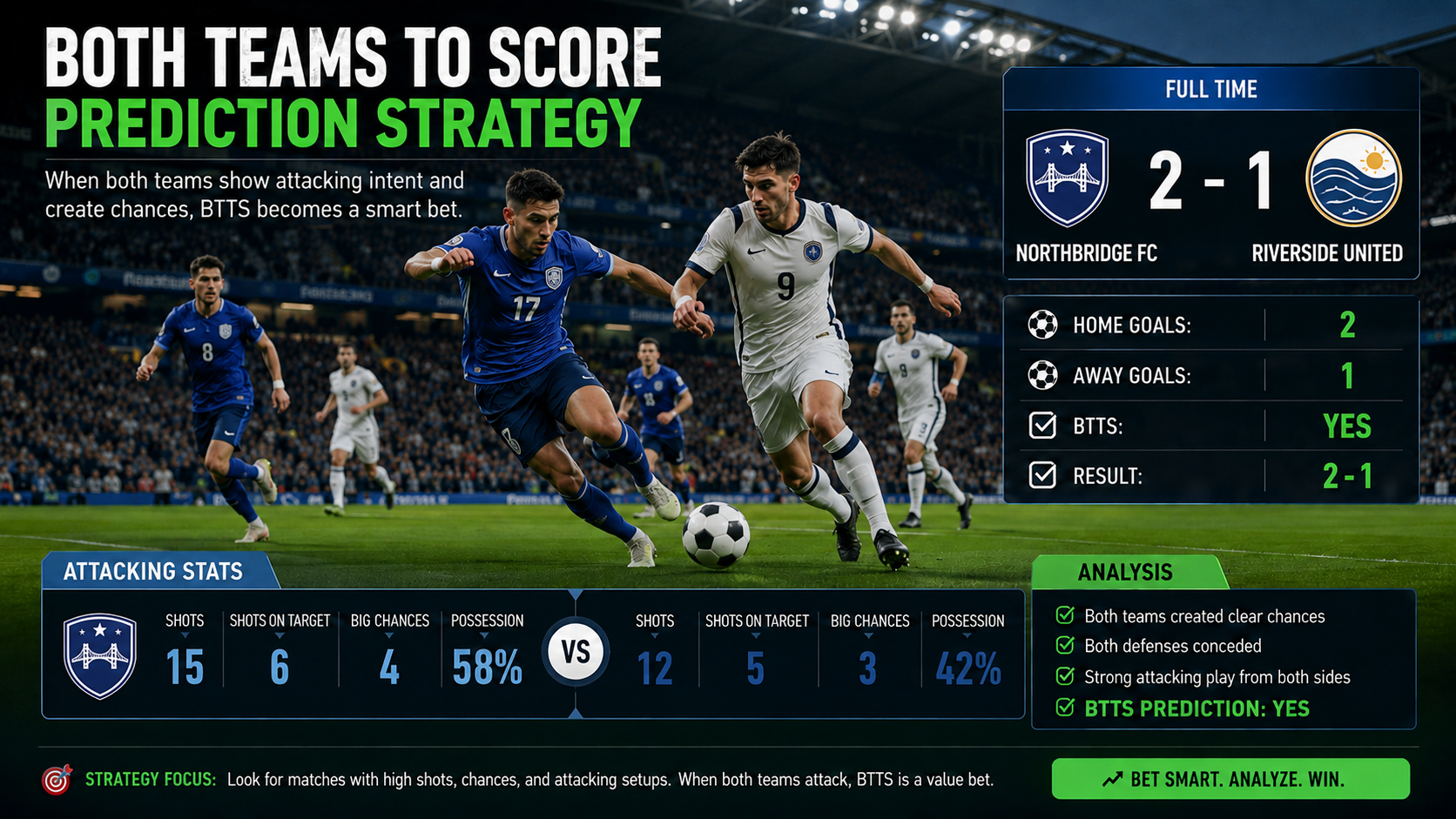
BTTS Prediction Strategy Explained
BTTS means “Both Teams To Score”. It is one of the most popular football betting markets because it focuses on whether both teams will score at least one goal in the match. You do not need to predict the final winner. You only need to decide whether both sides are likely to find the net.
A BTTS prediction wins when each team scores at least one goal. For example, these scorelines are winning BTTS results: 1-1, 2-1, 1-2, 2-2, 3-1, 1-3, 3-2, 4-2. If you expect at least two goals, our over 1.5 goals predictions may also be suitable.. These scorelines are losing BTTS results: 0-0, 1-0, 0-1, 2-0, 0-2, 3-0, 0-3, 4-0.
BTTS is a useful market because it allows you to focus on attacking and defensive patterns. A team can lose the match and still help your prediction win if it scores. This makes BTTS different from match-winner betting, where you must pick the correct result direction.
However, BTTS should not be predicted by guessing. A strong BTTS prediction comes from analysing scoring consistency, defensive weakness, recent form, home and away performance, head-to-head trends, team news, playing style and match motivation. Browse all our available markets on the football predictions page.
What Does BTTS Mean in Football Betting?
BTTS stands for Both Teams To Score. In simple terms, you are predicting whether both teams will score at least once during the match. The most common options are BTTS Yes and BTTS No.
BTTS Yes means you expect both teams to score. BTTS No means you expect at least one team not to score. If the match ends 1-1, 2-1, 3-1, 2-2 or 3-2, BTTS Yes wins. If the match ends 0-0, 1-0, 2-0, 0-1 or 3-0, BTTS Yes loses.
The final winner does not matter. A team can win, lose or draw, but both teams must score for BTTS Yes to win.
Check If Both Teams Score Regularly
The first step in a BTTS prediction strategy is to check whether both teams score regularly. A team that scores in most of its matches is more useful for BTTS than a team that often fails to score.
Look at each team’s last five to ten matches and check how many times they scored at least one goal. If both teams have scored in most of their recent games, the BTTS signal becomes stronger.
For example, if Team A has scored in eight of its last ten matches and Team B has scored in seven of its last ten matches, the match may be suitable for BTTS Yes. However, you must also check the type of opponents they faced. Scoring regularly against weak teams is different from scoring against strong defensive teams.
A good BTTS prediction is not only about one team scoring. Both teams must have enough attacking quality to contribute to the match.
Analyse Defensive Weakness
BTTS is often strongest when both teams can score but also concede. A team with a strong attack and weak defence can be very useful for BTTS markets because it is likely to score while also giving the opponent chances.
Check how often each team concedes. If both teams regularly concede goals, BTTS Yes becomes more realistic. For matches expected to have more goals, our over 2.5 goals predictions are worth considering. A team that keeps many clean sheets may reduce the chance of BTTS, especially if the opponent is weak in attack.
Important defensive signs to check include goals conceded, clean sheet record, shots allowed, big chances conceded, defensive injuries, goalkeeper form and errors leading to goals.
If both teams have defensive weaknesses, the chance of both sides scoring increases.
Study Recent BTTS Trends
Recent BTTS trends can show whether a team is regularly involved in matches where both sides score. Look at the last five to ten matches and count how many finished with BTTS Yes.
For example, if a team’s recent matches ended 2-1, 1-1, 3-2, 2-2 and 1-2, that is a strong BTTS pattern because both teams scored in every game. If another team’s results are 1-0, 0-0, 2-0, 0-1 and 3-0, BTTS may be weaker because one side often fails to score.
However, do not rely only on the pattern. You should understand why the pattern exists. Some teams play open football, while others are defensively poor. Some teams score often but concede because they attack with many players. The reason behind the trend matters.
Compare Home and Away Scoring Form
Home and away form is very important for BTTS predictions. Some teams score regularly at home but struggle away. Our home wins predictions and away wins predictions cover these patterns in detail. Others are dangerous on the counter-attack and can score even when playing away.
Before choosing BTTS Yes, check the home team’s home scoring record and the away team’s away scoring record. Also check how often the home team concedes at home and how often the away team concedes away.
A BTTS match becomes more attractive when the home team scores regularly at home but does not always keep clean sheets, and the away team scores regularly away but also concedes.
For example, a home team that wins many matches 2-1 or 3-1 may be useful for BTTS. An away team that regularly loses 2-1 or draws 1-1 may also support the prediction.
Look at Head-to-Head BTTS Records
Head-to-head results can help you understand how two teams usually play against each other. Some fixtures regularly produce goals for both sides because of playing styles, rivalry or defensive weakness.
Check the last five meetings between the teams and count how many ended with both teams scoring. Our draw predictions section covers matches with similar characteristics. If most recent meetings ended 1-1, 2-1, 1-2 or 2-2, BTTS Yes may be worth considering.
However, head-to-head records should not be used alone. Teams change managers, tactics and players. A meeting from several years ago may not reflect the current situation. Use head-to-head data as supporting evidence, not the main reason for your prediction.
Check Shots on Target and Chance Creation
A team must create chances to score. That is why shots on target and chance creation are very important for BTTS analysis.
A team that scores regularly but creates very few chances may not be reliable. It may be depending on penalties, long shots or individual mistakes. For precise scoreline predictions, visit our correct score predictions. On the other hand, a team that creates many chances but has been unlucky recently may still be dangerous for BTTS.
When analysing chance creation, check shots on target, big chances created, expected goals, attacking pressure, set-piece threat and creative players.
If both teams create chances regularly, BTTS Yes becomes stronger. If one team creates very little, BTTS becomes risky.
Use Expected Goals Where Available
Expected goals, also known as xG, can help you understand whether a team is creating good scoring opportunities. A team with strong attacking xG is usually more likely to score, even if recent results have not been perfect.
For BTTS predictions, you should look for matches where both teams have reasonable attacking xG. You should also check xG conceded because it shows whether a team allows opponents to create quality chances.
A strong BTTS profile may involve both teams creating decent xG and both teams conceding chances. This suggests that each side has a realistic chance of scoring.
Expected goals should not replace traditional analysis, but it can improve your decision when combined with form, team news and tactics.
Consider Team News Before Predicting BTTS
Team news can change a BTTS prediction quickly. If one team is missing its main striker, creative midfielder or best winger, its chance of scoring may reduce. If a team is missing key defenders or its first-choice goalkeeper, its chance of conceding may increase.
Before making a BTTS prediction, check whether the main attacking players are available. Also check if important defenders are injured or suspended.
A match may look good for BTTS based on form, but if one team has lost its main goal threat, the prediction becomes weaker. On the other hand, if both teams have attacking players available but defensive absences, BTTS may become stronger.
Understand Match Motivation
Motivation is important in football betting. A team that needs a win may attack more and take risks. This can create chances at both ends. A team that only needs a draw may play more cautiously, which can reduce BTTS chances. A double chance prediction can be useful when you expect a close contest.
BTTS can be attractive in matches where both teams need points. Relegation battles, promotion races and qualification matches can sometimes produce goals for both sides because teams are forced to attack. Countries like England often have competitive leagues with plenty of BTTS opportunities.
However, not every important match produces BTTS. Some high-pressure games become defensive and careful. For example, in Premier League matches, BTTS outcomes can vary significantly based on the teams involved. That is why motivation should be combined with team style and statistics.
Look at Playing Style
Playing style is one of the best ways to judge BTTS potential. Teams that press high, attack quickly and leave space behind are often involved in BTTS matches. They create chances but also allow opponents opportunities.
Teams that defend deep and rarely attack may not be suitable for BTTS unless they are very good on counter-attacks or set pieces.
BTTS Yes is more likely when both teams are willing to attack, both teams create chances, both teams have defensive gaps, and neither side is likely to sit back completely.
A balanced match with attacking intent from both sides is often better for BTTS than a one-sided match.
Be Careful with One-Sided Matches
One common mistake is choosing BTTS Yes when one strong team faces a very weak team. The strong team may score several goals, but the weaker team may fail to score. A 3-0 or 4-0 result loses BTTS Yes.
BTTS works best when both teams have a realistic chance of scoring. The match does not need to be perfectly balanced, but the weaker team must still have enough attacking ability to score at least once.
Before choosing BTTS Yes, ask whether the underdog can score. Do they create chances? Do they score away from home? Can they threaten through set pieces or counter-attacks? If the answer is no, BTTS Yes may be risky.
Best Signs for BTTS Yes
A match may be suitable for BTTS Yes when both teams score regularly, both teams concede often, both teams have attacking players available, both teams create shots on target, both teams have recent BTTS trends, both teams need a positive result, the home team does not keep many clean sheets, the away team can score away from home, defensive injuries are present, and the playing style is open.
The more signs you find, the stronger the BTTS prediction becomes. However, you should still avoid forcing BTTS on matches where one team has poor attacking numbers.
Common BTTS Prediction Mistakes
One common mistake is backing BTTS Yes only because both teams are popular or attacking by reputation. Reputation does not always reflect current form.
Another mistake is ignoring clean sheet records. If one team keeps clean sheets often and the opponent struggles to score, BTTS Yes may not be the best choice.
Some bettors also ignore home and away scoring differences. A team may score regularly at home but fail to score away. If the team is playing away, this must be considered.
Another mistake is choosing BTTS Yes in matches where one team is too dominant. A one-sided match can easily finish 2-0, 3-0 or 4-0, which would lose BTTS Yes.
To better understand related goal markets, you can read our comparison of over 2 vs over 2.5 goals and BTTS vs over 2.5 goals.
Final Thoughts
BTTS prediction strategy is about finding matches where both teams have a realistic chance of scoring. The best BTTS Yes predictions usually come from matches where both teams score regularly, concede often, create chances and play with enough attacking intent.
To improve your BTTS predictions, study recent scoring form, defensive records, BTTS trends, home and away performance, head-to-head results, shots on target, expected goals, team news, match motivation and playing style.
BTTS can be a useful football betting market because you do not need to predict the winner. However, it still requires careful analysis. Do not choose BTTS Yes just because a match looks exciting. Choose it when the statistics and match context support the prediction.
Responsible Betting Note: Football predictions are not guaranteed. Always bet responsibly, use proper money management, and never bet with money you cannot afford to lose.